How Can You Tell a Real Seashell From a Wooden Art Seashell


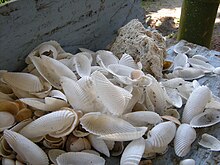

Mixed shells on a embankment in Venezuela

These are some unlike shells that vary in size, form and pattern combination.
A seashell or bounding main shell, likewise known simply equally a shell, is a hard, protective outer layer usually created by an animate being that lives in the sea. The shell is part of the trunk of the beast. Empty seashells are often institute washed up on beaches past beachcombers. The shells are empty because the creature has died and the soft parts have decomposed or been eaten by some other animal.
A seashell is usually the exoskeleton of an invertebrate (an beast without a backbone), and is typically composed of calcium carbonate or chitin. Most shells that are institute on beaches are the shells of marine mollusks, partly because these shells are normally made of calcium carbonate, and endure ameliorate than shells made of chitin.
Apart from mollusk shells, other shells that tin can be found on beaches are those of barnacles, horseshoe crabs and brachiopods. Marine annelid worms in the family Serpulidae create shells which are tubes made of calcium carbonate cemented onto other surfaces. The shells of sea urchins are chosen "tests", and the moulted shells of crabs and lobsters are exuviae. While most seashells are external, some cephalopods accept internal shells.
Seashells take been used by humans for many dissimilar purposes throughout history and prehistory. Notwithstanding, seashells are not the merely kind of shells; in various habitats, there are shells from freshwater animals such as freshwater mussels and freshwater snails, and shells of land snails.
Terminology [edit]
When the discussion "seashells" refers but to the shells of marine mollusks, then studying seashells is office of conchology. Conchologists or serious collectors who take a scientific bias are in general careful not to disturb living populations and habitats: even though they may collect a few live animals, almost responsible collectors do non often over-collect or otherwise disturb ecosystems.
The study of the entire molluscan fauna (as well as the crush) is known as malacology; a person who studies mollusks is known every bit a malacologist.
Occurrence [edit]
Seashells are commonly found in beach migrate, which is natural detritus deposited along strandlines on beaches past the waves and the tides. Shells are very often washed upward onto a embankment empty and make clean, the beast having already died.
Empty seashells are oft picked up by beachcombers. All the same, the majority of seashells which are offered for auction commercially have been collected live (frequently in bulk) and and then killed and cleaned, specifically for the commercial trade.[1] This blazon of large-scale exploitation can sometimes have a potent negative touch on local ecosystems, and sometimes can significantly reduce the distribution of rare species.
Shell synthesis [edit]
Seashells are created from the molluscs that employ them for habitation and protection.[2] Molluscs have an exterior layer of tissues on their bodies – the pall – which connects the shell to the mollusc. The mantle layer of tissues, makes the shell itself. The specialized cells in the mantle form the vanquish using different minerals and proteins.[2] The proteins are then used to create the framework that supports the growing trounce. Calcium carbonate is the chief compound of shell structure, aiding in adhesion.[two]
Molluscan seashells [edit]
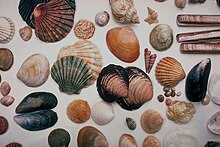

The discussion seashell is often used to mean only the shell of a marine clam. Marine mollusk shells that are familiar to beachcombers and thus most likely to be chosen "seashells" are the shells of marine species of bivalves (or clams), gastropods (or snails), scaphopods (or tusk shells), polyplacophorans (or chitons), and cephalopods (such as nautilus and spirula). These shells are very frequently the most normally encountered, both in the wild, and for auction equally decorative objects.
Marine species of gastropods and bivalves are more numerous than land and freshwater species, and the shells are often larger and more robust. The shells of marine species likewise often have more sculpture and more color, although this is by no means always the case.
In the tropical and sub-tropical areas of the planet, there are far more species of colorful, large, shallow water shelled marine mollusks than in that location are in the temperate zones and the regions closer to the poles.
Although there are a number of species of shelled mollusks that are quite large, there are vast numbers of extremely small species besides, meet micromollusks.
Not all mollusks are marine. There are numerous land and freshwater mollusks, run into for case snail and freshwater bivalves. In add-on, not all mollusks take an external shell: some mollusks such as some cephalopods (squid and octopuses) take an internal trounce, and many mollusks have no vanquish, come across for example slug and nudibranch.
Bivalves [edit]

Bivalves are frequently the virtually common seashells that wash up on large sandy beaches or in sheltered lagoons. They can sometimes be extremely numerous. Very often the 2 valves become separated.
There are more than 15,000 species of bivalves that live in both marine and freshwater. Examples of bivalves are clams, scallops, mussels, and oysters. The majority of bivalves consist of two identical shells that are held together by a flexible hinge. The animal's torso is held protectively inside these 2 shells. Bivalves that exercise non have two shells either accept i shell or they lack a crush altogether. The shells are made of calcium carbonate and are formed in layers past secretions from the drapery. Bivalves, too known as pelecypods, are mostly filter feeders; through their gills, they describe in water, in which is trapped tiny food particles. Some bivalves accept eyes and an open circulatory organization. Bivalves are used all over the earth every bit food and as a source of pearls. The larvae of some freshwater mussels can be unsafe to fish and can diameter through wood.
Shell Beach, Western Commonwealth of australia, is a embankment which is entirely fabricated up of the shells of the crinkle Fragum erugatum.
Gastropods [edit]
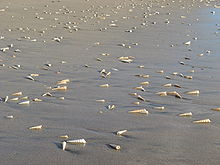
Certain species of gastropod seashells (the shells of sea snails) can sometimes be common, washed up on sandy beaches, and besides on beaches that are surrounded by rocky marine habitat.
Polyplacophorans [edit]

Chiton plates or valves ofttimes wash up on beaches in rocky areas where chitons are common. Chiton shells, which are equanimous of eight split up plates and a girdle, usually come apart non long later on death, and so they are almost always found equally disarticulated plates. Plates from larger species of chitons are sometimes known as "butterfly shells" considering of their shape.
Cephalopods [edit]

Cuttlebone from a Sepia sp.

Only a few species of cephalopods have shells (either internal or external) that are sometimes institute done up on beaches.
Some cephalopods such as Sepia, the cuttlefish, take a large internal shell, the cuttlefish bone, and this often washes up on beaches in parts of the world where cuttlefish are mutual.
Spirula spirula is a deep water squid-like cephalopod. It has an internal shell which is pocket-sized (about ane in or 24 mm) but very calorie-free and buoyant. This chambered shell floats very well and therefore washes up hands and is familiar to beachcombers in the torrid zone.
Nautilus is the simply genus of cephalopod that has a well-developed external beat out. Females of the cephalopod genus Argonauta create a papery egg case which sometimes washes up on tropical beaches and is referred to every bit a "newspaper nautilus".
The largest grouping of shelled cephalopods, the ammonites, are extinct, just their shells are very common in certain areas as fossils.
Molluscan seashells used past other animals [edit]
Empty molluscan seashells are a sturdy, and usually readily available, "free" resource which is often hands found on beaches, in the intertidal zone, and in the shallow subtidal zone. As such they are sometimes used second-hand by animals other than humans for various purposes, including for protection (equally in hermit crabs) and for construction.
Mollusks [edit]
- Carrier shells in the family Xenophoridae are marine shelled gastropods, fairly big sea snails. Most species of xenophorids cement a serial of objects to the rim of their shells as they grow. These objects are sometimes pocket-size pebbles or other difficult detritus. Very often shells of bivalves or smaller gastropods are used, depending on what is available on the particular substrate where the snail itself lives. It is not clear whether these beat out attachments serve equally camouflage, or whether they are intended to aid foreclose the shell sinking into a soft substrate.

An ocellated (spotted) octopus using a clamshell every bit a shelter
- Small octopuses sometimes use an empty shell as a sort of cave to hide in, or concord seashells around themselves as a grade of protection like a temporary fortress.
Invertebrates [edit]

- Almost all genera of hermit crabs use or "wear" empty marine gastropod shells throughout their lifespan, in order to protect their soft abdomens, and in order to take a strong shell to withdraw into if attacked by a predator. Each individual hermit crab is forced to discover another gastropod shell on a regular ground, whenever it grows as well large for the one it is currently using.
- Some hermit crab species live on land and may be found quite some altitude from the sea, including those in the tropical genus Coenobita.
Conchology [edit]
There are numerous popular books and field guides on the discipline of shell-collecting. Although there are a number of books about state and freshwater mollusks, the majority of popular books emphasize, or focus exclusively on, the shells of marine mollusks. Both the scientific discipline of studying mollusk shells and the hobby of collecting and classifying them are known equally conchology. The line betwixt professionals and amateur enthusiasts is often non well defined in this subject, because many amateurs accept contributed to, and go on to contribute to, conchology and the larger science of malacology. Many shell collectors belong to "trounce clubs" where they tin can run into others who share their interests. A large number of amateurs collect the shells of marine mollusks, and this is partly because many shells wash up empty on beaches, or alive in the intertidal or sub-tidal zones, and are therefore hands establish and preserved without much in the way of specialized equipment or expensive supplies. Some shell collectors find their own material and proceed careful records, or purchase only "specimen shells", which means shells which have full collecting data: information including how, when, where, in what habitat, and by whom, the shells were collected. On the other hand, some collectors buy the more widely available commercially imported exotic shells, the majority of which have very lilliputian data, or none at all. To museum scientists, having total collecting data (when, where, and past whom information technology was collected) with a specimen is far more important than having the shell correctly identified. Some owners of shell collections hope to be able to donate their drove to a major natural history or zoology museum at some point, however, shells with lilliputian or no collecting information are usually of no value to science, and are probable not to exist accepted by a major museum. Apart from any damage to the shell that may have happened before it was nerveless, shells can too suffer impairment when they are stored or displayed. For an instance of one rather serious kind of damage see Byne's affliction.
Beat clubs [edit]
There are a number of clubs or societies which consist of people who are united by a shared interest in shells. In the United states, these clubs are more common in southerly littoral areas, such as Florida and California, where the marine fauna is rich in species.
Identification [edit]
Seashells are usually identified by consulting general or regional beat-collecting field guides, and specific scientific books on different taxa of trounce-bearing mollusks (monographs) or "iconographies" (limited text – mainly photographs or other illustrations). (For a few titles on this subject in the U.s., see the listing of books at the foot of this article.) Identifications to the species level are generally achieved by examining illustrations and written descriptions, rather than past the utilize of Identification keys, every bit is frequently the case in identifying plants and other phyla of invertebrates. The structure of functional keys for the identification of the shells of marine mollusks to the species level can be very hard, because of the slap-up variability within many species and families. The identification of certain individual species is ofttimes very difficult, even for a specialist in that particular family. Some species cannot be differentiated on the basis of shell character lone.
Numerous smaller and more obscure mollusk species (see micromollusk) are yet to exist discovered and named. In other words, they have not yet been differentiated from similar species and assigned scientific (binomial) names in articles in journals recognized by the International Commission on Zoological Nomenclature (ICZN). Large numbers of new species are published in the scientific literature each year. There are currently an estimated 100,000 species of mollusks worldwide.
Non-marine "seashells" [edit]
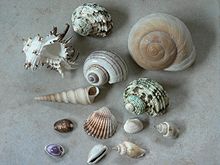
A group of purchased (mostly marine) shells includes the shell of a large tropical country snail (upper right), and a shiny freshwater apple snail shell (center)
The term seashell is also practical loosely to mollusk shells that are not of marine origin, for example by people walking the shores of lakes and rivers using the term for the freshwater mollusk shells they encounter. Seashells purchased from tourist shops or dealers may include various freshwater and terrestrial shells also. Non-marine items offered may include large and colorful tropical land snail shells, freshwater apple snail shells, and pearly freshwater unionid mussel shells. This can be confusing to collectors, every bit non-marine shells are often not included in their reference books.
Cultural significance [edit]
Currency [edit]
Seashells take been used as a medium of exchange in various places, including many Indian Sea and Pacific Ocean islands, likewise in North America, Africa and the Caribbean.
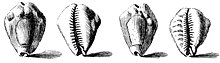
- The almost common species of shells to be used as currency take been Monetaria moneta, the "coin cowry",[3] [4] and certain dentalium tusk shells, used in North Western Due north America for many centuries.
- Many of the tribes and nations all across the continent of Africa have historically used the cowry as their media of commutation. The cowry circulated, historically, alongside metal coins and goods, and foreign currencies. Existence durable and like shooting fish in a barrel to carry the cowry made a very favorable currency.
- Some tribes of the ethnic peoples of the Americas used shells for wampum and pilus pipes.[five] The Native American wampum belts were made of the trounce of the quahog clam.
Tools [edit]
Seashells accept oft been used as tools, because of their strength and the variety of their shapes.
- Giant clams (Family Tridacnidae) accept been used as bowls, and when large plenty, even as bathtubs and baptismal fonts.
- Melo melo, the "bailer volute", is so named because Native Australians used it to bail out their canoes.
- Many different species of bivalves have been used as scrapers, blades, clasps, and other such tools, due to their shape.
- Some marine gastropods have been used for oil lamps, the oil existence poured in the aperture of the vanquish, and the siphonal canal serving equally a holder for the wick.
Horticulture [edit]
Considering seashells are in some areas a readily bachelor majority source of calcium carbonate, shells such as oyster shells are sometimes used equally soil conditioners in horticulture. The shells are broken or footing into small pieces in gild to have the desired issue of raising the pH and increasing the calcium content in the soil.
Organized religion and spirituality [edit]

A sacred chank shell on the flag of Travancore, India
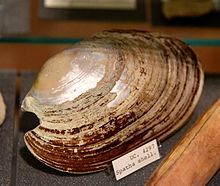
Spatha shell. From Naqada tomb 1539, Egypt. Naqada I menstruation. The Petrie Museum of Egyptian Archaeology, London
Seashells take played a part in religion and spirituality, sometimes even as ritual objects.
- In Christianity, the scallop shell is considered to be the symbol of Saint James the Nifty, see Pecten jacobaeus.[6]
- In Hinduism, left-handed shells of Turbinella pyrum (the sacred shankha) are considered to exist sacred to the god Vishnu. The person who finds a left-handed chank beat out (i that coils to the left) is sacred to Vishnu, too. The chank shell also plays an important role in Buddhism.
- Cowries accept often been considered to be symbols of female fertility. They were oftentimes treated as actual fertility charms. The dorsum of the shell resembles a meaning belly, and the underside of the shell resembles a vulva. In the South Indian state of Kerala, cowries are used for making astrological predictions.
- In the Santería religion, shells are used for divination.
- The Moche culture of aboriginal Peru worshipped animals and the ocean, and often depicted shells in their fine art.[7]
- In Christianity, the top of the sand dollar represents the Star of Bethlehem that led the Wise Men to the manger of Christ. Outside the "star" you will see the Easter Lily, a sign of Jesus' Resurrection. There are iv holes that represent the holes in the Lord's hands and feet. The center pigsty is the Wound to His Sacred Heart by the spear of Longinus. On the other side of the sand dollar, yous will see Poinsettia. Lastly, if you intermission open the sand dollar, 5 doves volition come up out, the doves of Peace and Joy.[eight]
Musical instruments [edit]

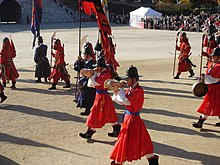
Korean armed forces procession with Charonia trumpets
Seashells have been used as musical instruments, current of air instruments for many hundreds if not thousands of years. Nearly often the shells of large sea snails are used, as trumpets, by cut a pigsty in the spire of the beat out or cut off the tip of the spire birthday. Various different kinds of large marine gastropod shells can be turned into "blowing shells", however the most ordinarily encountered species used as "conch" trumpets are:
- The sacred chank, Turbinella pyrum, known in India as the shankha. In Tibet it is known as "dung-dkar".[nine]
- The Triton shell also known equally "Triton's trumpet" Charonia tritonis which is used as a trumpet in Melanesian and Polynesian culture and also in Korea and Japan. In Japan this kind of trumpet is known equally the horagai. In Korea it is known as the nagak. In some Polynesian islands it is known as "pu".[9]
- The Queen Conch Lobatus gigas, has been used every bit a trumpet in the Caribbean area.
Children in some cultures are often told the myth that yous can hear the audio of the sea past holding a seashell to ones ear. This is due to the effect of seashell resonance.
Personal adornment [edit]
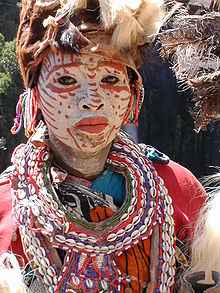

Whole seashells or parts of sea shells have been used as jewelry or in other forms of adornment since prehistoric times. Mother of pearl was historically primarily a seashell product, although more than recently some female parent of pearl comes from freshwater mussels. Also meet pearl.
- Beat out necklaces have been establish in Stone Age graves as far inland as the Dordogne Valley in French republic.
- Seashells are often used whole and drilled, so that they can exist threaded like beads, or cut into pieces of various shapes. Sometimes shells can be found that are already "drilled" by predatory snails of the family Naticidae. Fine whole shell necklaces were made by Tasmanian Aboriginal women for more than two,600 years. The necklaces represent a meaning cultural tradition which is still practised by Palawa women elders. The shells used include pearly green and blue-green maireener (rainbow kelp) shells, brown and white rice shells, black cats' teeth shells and pink push shells.[10]
- Naturally-occurring, beachworn, cone trounce "tops" (the broken-off spire of the shell, which often has a hole worn at the tip) can function as chaplet without any further modification. In Hawaii these natural beads were traditionally collected from the beach drift in guild to make puka shell jewelry. Since information technology is hard to obtain large quantities of naturally-occurring beachworn cone tops, almost all modern puka beat out jewelry uses cheaper imitations, cut from thin shells of other species of mollusk, or even made of plastic.
- Shells historically have been and still are made into, or incorporated into, necklaces, pendants, beads, earrings, buttons, brooches, rings, hair combs, belt buckles and other uses.
- The crush of the big "bullmouth helmet" sea snail, scientific name Cypraecassis rufa, was historically, and still is, used to make valuable cameos.
- Female parent of pearl from many seashells including species in the family Trochidae, Turbinidae, Haliotidae, and various pearly bivalves, has often been used in jewelry, buttons, etc.
- In London, Pearly Kings and Queens traditionally wear clothing covered in patterns made up of hundreds of "pearl buttons", in other words, buttons made of mother-of-pearl or nacre. In recent years yet, the bulk of "pearl buttons" are imitations that are made of pearlescent plastic.
Creating Crafts [edit]
"Sailor's Valentines" were late 19th-century decorative keepsakes which were made from the Caribbean area, and which were often purchased by sailors to requite to their loved ones back domicile for case in England. These valentines consisted of elaborate arrangements of small-scale seashells glued into attractive symmetrical designs, which were encased on a wooden (usually octagonal) hinged box-frame. The patterns used often featured heart-shaped designs, or included a sentimental expression of dearest spelled out in small shells.
The making of shell work artifacts is a practice of Ancient women from La Perouse in Sydney, dating back to the 19th century. Vanquish piece of work objects include babe shoes, jewelry boxes and replicas of famous landmarks, including the Sydney Harbour Bridge and the Sydney Opera Business firm. The shellwork tradition began as an Aboriginal women'south craft which was adjusted and tailored to suit the tourist souvenir market place, and which is now considered high art.[xi]
Architectural decoration [edit]
Small pieces of colored and iridescent shell have been used to create mosaics and inlays, which have been used to decorate walls, furniture and boxes. Big numbers of whole seashells, arranged to form patterns, take been used to decorate mirror frames, piece of furniture and human being-fabricated grottos.
Art [edit]

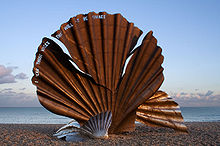


Illustration from an 18th-century book, edited past Albertus Seba. These decorative arrangements were a popular way to display seashells at the fourth dimension

Portrait of the Shell Collector Jan Govertsen van der Aer, by Hendrick Goltzius (1603)
A very big outdoor sculpture at Akkulam of a gastropod seashell is a reference to the sacred chank shell Turbinella pyrum of India. In 2003, Maggi Hambling designed a striking xiii ft (4 chiliad) high sculpture of a scallop vanquish which stands on the embankment at Aldeburgh, in England. The goddess of love, Venus or Aphrodite, is often traditionally depicted ascension from the bounding main on a seashell. In The Birth of Venus, Botticelli depicted the goddess Venus rising from the ocean on a scallop beat.
Poultry feeds [edit]
Sea shells plant in the creek and backwater of the coast of west India are used as an additive to poultry feed. They are crushed and mixed with jowar maize and dry fish.[ citation needed ]
Use [edit]
Seashells, namely from bivalves[12] and gastropods, are fundamentally composed of calcium carbonate. In this sense, they have potential to be used as raw material in the production of lime.
Along the Gulf Coast of the United States, oyster shells were mixed into cement to make "shellcrete" which could form bricks, blocks and platforms. It could also be applied over logs.[13] A notable example is the 19th-century Sabine Pass Lighthouse in Louisiana, near Texas.[14]
Shells of other marine invertebrates [edit]
Arthropods [edit]

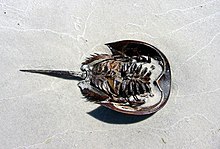
Many arthropods have sclerites, or hardened body parts, which grade a stiff exoskeleton made up more often than not of chitin. In crustaceans, especially those of the course Malacostraca (venereal, shrimps and lobsters, for instance), the plates of the exoskeleton may be fused to form a more than or less rigid carapace. Moulted carapaces of a variety of marine malacostraceans often wash up on beaches. The horseshoe crab is an arthropod of the family Limulidae. The shells or exuviae of these arachnid relatives are common in beach drift in certain areas of the earth.
Echinoderms [edit]

Some echinoderms such as ocean urchins, including heart urchins and sand dollars, have a hard "test" or trounce. Afterwards the animal dies, the flesh rots out and the spines autumn off, and then adequately often the empty test washes up whole onto a beach, where it can be found by a beachcomber. These tests are fragile and easily broken into pieces.
Brachiopods [edit]

A whole animal of the brachiopod Lingula anatina from Australia with the shell showing on the left
The brachiopods, or lamp shells, superficially resemble clams, just the phylum is not closely related to mollusks. Nigh lines of brachiopods ended during the Permian-Triassic extinction effect, and their ecological niche was filled by bivalves. A few of the remaining species of brachiopods occur in the low intertidal zone and thus tin be found live by beachcombers.
Annelids [edit]
Some polychaetes, marine annelid worms in the family unit Serpulidae, secrete a hard tube made of calcium carbonate, adhering to stones or other shells. This tube resembles, and can be confused with, the shell of marine gastropod mollusks in the family Vermetidae, the worm snails.
Other more atypical kinds [edit]
A few other categories of marine animals leave remains which might be considered "seashells" in the widest possible sense of the give-and-take.
Chelonians [edit]
Sea turtles have a carapace and plastron of bone and cartilage which is developed from their ribs. Infrequently a turtle "shell" will wash up on a embankment.
Difficult corals [edit]

Dish with beachworn coral pieces, marine gastropod shells, and echinoderm tests, from the Caribbean and the Mediterranean
Pieces of the hard skeleton of corals commonly wash upwards on beaches in areas where corals grow.
The structure of the shell-like structures of corals are aided by a symbiotic human relationship with a form of algae, zooxanthellae. Typically a coral polyp will harbor particular species of algae, which will photosynthesise and thereby provide energy for the coral and assistance in calcification,[15] while living in a safe surround and using the carbon dioxide and nitrogenous waste produced by the polyp. Coral bleaching is a disruption of the residue between polyps and algae, and can pb to the breakdown and death of coral reefs.
Soft corals [edit]

The skeletons of soft corals such as gorgonians, also known as sea fans and body of water whips, commonly wash ashore in the tropics afterward storms.
Plankton and protists [edit]
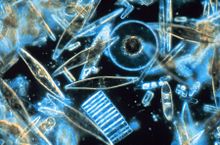
Marine diatoms course hard silicate shells
Plant-similar diatoms and animal-like radiolarians are two forms of plankton which form hard silicate shells. Foraminifera and coccolithophores create shells known as "tests" which are fabricated of calcium carbonate. These shells and tests are usually microscopic in size, though in the example of foraminifera, they are sometimes visible to the naked eye, ofttimes resembling miniature mollusk shells.
Run into also [edit]
- Bailey-Matthews Shell Museum
- Marine biogenic calcification
- Mollusk crush
- Ocean acidification
- Seashell resonance
- Seashell surface, a mathematical construct
- Shell growth in estuaries
- Shell purse
- Small shelly animate being
References [edit]
Citations [edit]
- ^ "Seashell Souvenirs Are Killing Protected Marine Life". Animals. sixteen July 2018. Retrieved 19 March 2019.
- ^ a b c "How are seashells made?". Woods Hole Oceanographic Institution. 2022. Retrieved 21 March 2022.
- ^ Poutiers, J. K. (1998). "Gastropods". FAO Species Identification Guide for Fishery Purposes: The living marine resources of the Western Central Pacific (PDF). Vol. ane. Seaweeds, corals, bivalves and gastropods. Rome: FAO. p. 503.
- ^ Hogendorn, Jan and Johnson Marion: The Trounce Money of the Slave Trade. African Studies Series 49, Cambridge University Press, Cambridge, 1986.
- ^ Ewers, John C. "Hair Pipes in Plains Indian Adornment", Agency of American Ethnology Message 164, pp. 29–85. Usa Government Printing Office, Washington : 1957.
- ^ Raichlen, Steven. "The venerable scallop'southward versatility makes it a rare culinary blessing". baltimoresun.com . Retrieved 12 Nov 2020.
- ^ Berrin, Katherine & Larco Museum. The Spirit of Ancient Peru:Treasures from the Museo Arqueológico Rafael Larco Herrera. New York: Thames and Hudson, 1997.
- ^ The Legend of the Sand Dollar
- ^ a b Clark, Mitchell (1996). "Some Basics on Shell Trumpets and some very Nuts on how to make them". furious.com. Archived from the original on 21 October 2013. Retrieved 24 July 2016.
- ^ Tasmanian Aboriginal crush necklaces Archived 12 June 2011 at the Wayback Machine, National Museum of Australia.
- ^ "Shellwork Sydney Harbour Bridge". National Museum of Australia Collections. Archived from the original on 30 January 2019.
- ^ Ferraz, Eduardo; Gamelas, José A. F.; Coroado, João; Monteiro, Carlos; Rocha, Fernando (12 July 2019). "Recycling Waste Seashells to Produce Calcitic Lime: Characterization and Wet Slaking Reactivity". Waste and Biomass Valorization. 10: 2397–2414. doi:10.1007/s12649-018-0232-y. ISSN 1877-2641.
- ^ Preservation News. National Trust for Celebrated Preservation in the United States. 1985. p. 94.
Brittle buildings made of "shellcrete," a seashell-cement mix applied over logs, are risky to move.
- ^ Tunnell, John Wesley (2010). Encyclopedia of Texas Seashells. Texas A&M U. Press. pp. 17–19. ISBN978-one-60344-337-one.
Many impressive sometime homes and public buildings, too as more mundane structures such as cisterns and curbs, were constructed of shellcrete bricks in Corpus Christi, Galveston, and other cities forth the coast. However, very few exist today.
- ^ Madl, P. & Yip, M. (2000). "Field Circuit to Milne Bay Province - Papua New Guinea". Archived from the original on 28 Jan 2012. Retrieved 31 March 2006.
Sources [edit]
- Books
- Abbott R. Tucker & S. Peter Trip the light fantastic, 1982, Compendium of Seashells, A full color guide to more than 4,200 of the World's Marine shells, E.P. Dutton, Inc, New York, ISBN 0-525-93269-0.
- Abbott R. Tucker, 1985, Seashells of the World: a guide to the better-known species, 1985, Golden Printing, New York, ISBN 0-307-24410-5.
- Abbott, R. Tucker, 1986, Seashells of Due north America, St. Martin'southward Press, New York, ISBN 1-58238-125-9.
- Abbott, R. Tucker, 1974, American Seashells, Second edition, Van Nostrand Rheinhold, New York, ISBN 0-442-20228-8.
External links [edit]
 | Look up seashell in Wiktionary, the complimentary lexicon. |
 | Wikimedia Commons has media related to Seashells. |
 | Wikiquote has quotations related to: Seashell |
- Hohlman Vanquish Drove, Florida Institute of Technology
curtismostanquest.blogspot.com
Source: https://en.wikipedia.org/wiki/Seashell
0 Response to "How Can You Tell a Real Seashell From a Wooden Art Seashell"
Post a Comment